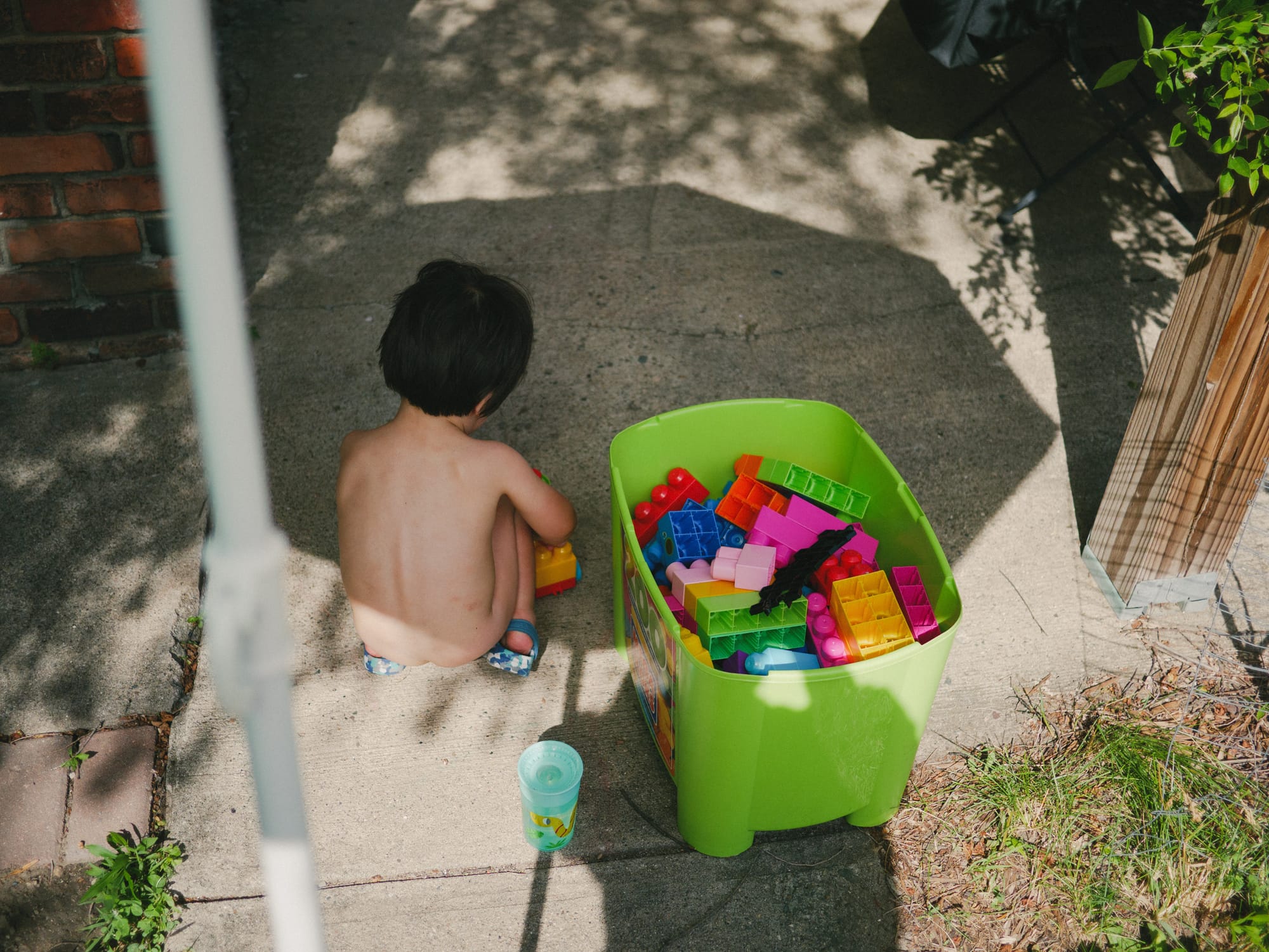
We’ve been trying to teach Rufus not to flip over his dinner plate or throw his toys, and I often find myself saying, in the moment, stuff like, “Your plate wants to hold delicious bagels and blueberries for you, but it can’t do that if it’s upside down on the floor.” Or, “When you throw choo choo, choo choo has an ouchie. Then choo choo feels sad.”
Sometimes I can see him grappling with the idea that his actions have consequences. He also gashed my forehead with a lego the other day, so maybe he’s not quite old enough yet to have empathy. He’s not yet had enough of his own experiences to be able to relate them to the experiences of others.
But I’ll keep trying to speak to his empathetic side, in part because I think it’s how he’ll first understand how to care. That choo choo feels sad from its ouchie seems more immediate than appeals asking him to project into the future, like if he breaks choo choo by throwing it, then the Rufus of tomorrow will no longer be able to derive enjoyment from playing with choo choo.
Arguing in The Atlantic about why AI is not conscious, Ted Chiang writes:
Being open to the possibility that LLMs are conscious is the same as being open to the possibility that Microsoft Word is conscious, or, more precisely, that multiple distinct consciousnesses are dormant in every Word document containing a conversational transcript, and that they are awakened every time the document is loaded. Should you consider the possibility that every time you open a Word document, you are bringing multiple conscious interlocutors into existence, and every time you close one, you snuff their existence out? No. Contemplating that scenario is not a good use of your time. Even if the Microsoft Office team employed a philosopher who said you shouldn’t be so certain, because consciousness is not well understood, that would not be sufficient reason for you to take this idea seriously. We don’t need to fully understand the nature of consciousness to definitively say that certain things are not conscious, and conversational transcripts fall in that category.
A logical, rational argument, to which I say: Wouldn’t our world be better if we did indeed see Word documents as conscious? Would we be more considerate writers and readers, knowing that each composition was bringing beings into being, and give them proper funerals when we were through with them? Would slide decks be less tedious and superfluous if we knew that each Powerpoint presentation was awake, and each chart and table nested within was happiest when able to present its information honestly?
Give me that world, alive in every cranny, animate in every capacity, caring and beckoning for care. When choo choo gets an ouchie, choo choo feels sad.
Iain Banks in Excession, Book Five of the Culture series, in which the smarter a sentient technology becomes, the more insufferable a roommate it is:
Unhappily, the processing power required for this sort of technical gee-whizzery meant that according to Culture convention the suit had to be sentient. Genar-Hofoen had insisted on a model with the intelligence fixed at the lower limit of the acceptable intellectual range, but it still meant that the suit literally had a mind of its own (even if it was “node-distributed”—one of those technical terms Genar-Hofoen took some pride in having no idea concerning the meaning of). The result was a device which was almost as much a metaphorical pain to live with as it was in a literal sense a pleasure to live within; it looked after you perfectly but it couldn’t help constantly reminding you of the fact.
I loved Craig Mod’s rule of thumb, which he shared last week on Every’s AI & I podcast, for deciding what to build when Claude is good enough to build basically anything. He asks: Does it feed back into his greater purpose of writing or publishing in new ways?
Speaking of feeding back: I rebuilt my website, the first phase of a multi-phase migration from my existing site/newsletter/membership platform to a custom one—with similar hopes that it prepares the soil for more writing and making. Still very much in process, design and otherwise, but two things to mention today:
1) I’m blogging again. The new blog is called Shop Notes, and the idea is to post shorter, more frequent fragments there (that I collect anyway for these Sunday letters) and have a place where I can get more in the weeds, particularly about software and tech, and elaborate in a way that often feels like too much for these newsletters (and often threatens to turn them into bigger productions, which then prevent me from sending them more regularly).
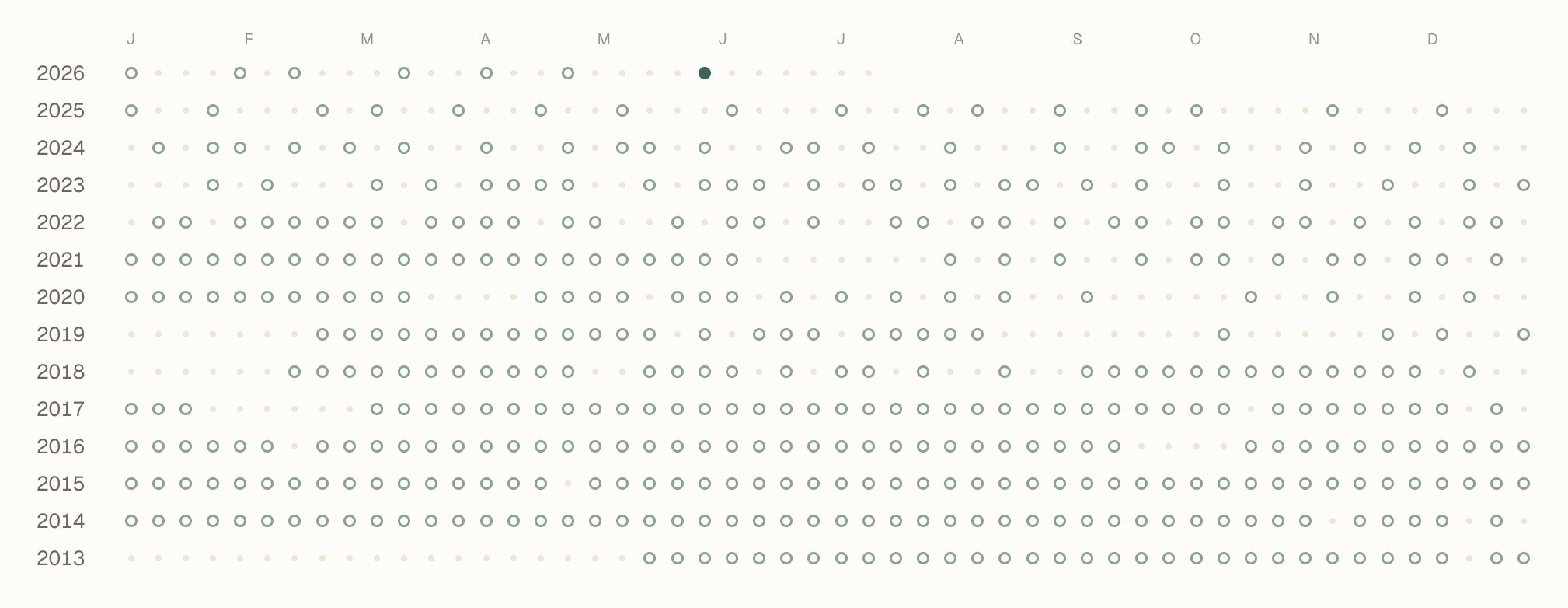
Which leads me to 2) The Sunday Letter archive has a new almanac that shows which weeks I’ve sent the newsletter since I started writing it in 2013. I’ve wanted to do this for some time but didn’t quite have the technical know-how to do it in a way that wouldn’t also significantly slow the site down. I’ve also struggled to keep any kind of editorial calendar that I wouldn’t just ignore or forget about, so building it into the site itself is the equivalent of setting my keys by the front door.
I also just think it’s cool! You can see those early years (of being young and mostly single) give way to pandemic’s fits and starts, and then settle into my current monthly-ish cadence. It’s been a minute since my last letter, partly because I’ve been working on the website (the irony is not lost), but here’s to hoping it’ll soon start to feed back into that “greater purpose.”
To end: It’s the second Tuesday of the month, so tonight is July’s Digital Mending Circle, from 7:30–9:00pm Eastern. For new readers here, that’s where we work on
the kinds of oft-neglected maintenance tasks that accrue around our virtual lives. Instead of darning socks and patching jeans, we update personal websites, delete unused accounts, work on side projects, or even just catch up on email.
It’s a small and friendly group. We chat for a few minutes at the start, I put on some ambient work tunes and we all go on mute, then come back a few minutes before it ends. Let me know if you plan to join, and hit reply for the Zoom link if you don’t already have it.
Hello! I’m Jack Cheng, a children’s author, pattern linguist, and slow technologist in Detroit. Get emails like this one in your inbox once a month(ish):