I’ve been playing around with the Jev model in early access. Think of it as a universal sorter. By itself it can classify streams of text near instantly but wire it up to a few other tools and …
Shop Notes
Creative process, ideas, and inspirations. By Jack Cheng.
RSS / Bluesky / Mastodon
You either die a hero or live long enough to see your AI notetaker app make a smart ring
Batch Computing, Suckling the Big Pig
My weekly Claude Fable limit resets every Tuesday. I usually work through it in a day or two, then I have to wait again. So I’ve noticed myself saving up more ambitious asks the rest of the week, waiting until I have time with the model again. It reminds me of computing history accounts of time-sharing mainframes.
[O]ne person at a time could use the computer, and so you tended to use punch cards, and you tended to set up test runs to get the most out of your turn on the computer, and then you were off again and trying to figure out what your results were, and then put in another set of runs. So it was hardly what you’d call interactive: very batch-oriented and very scheduled and very measured, in terms of when you could get on.
[W]e’d travel to some other building where the computers were, and feed those cards into a machine and they would print out some answers internally, and a new set of cards would be punched out, with our answers on that new set of cards. And then we’d physically take those cards over to another machine that would print out the answers on great big huge sheets.
To avoid racking up charges, I’d write out as much of my program as I could with pen and paper before elbowing into my place at the machine […] Typically there was a gaggle of other kids waiting for the computer, so if my program didn’t work, I’d have to log off and find a spot to sort through where I went wrong, then wait my turn to get back on the teletype.
You had to really reason through your solution, because you’d submit it and maybe you’d wait 24 hours [for the results]. There’s a certain kind of experimentation you can do when you don’t have to worry about turnaround, but there’s also a certain amount of sloppiness you get into, and we went through a stage in which that was the issue.
[W]hen you scheduled time days—if not a week—in advance, you didn’t go down and see what happens; you made pretty sure it was [correct].
[T]here was a big notice over the computer—I think it was [a play on the one] devised by IBM— which said, “Think—but not here!”
I always thought of it as something like a factory. You have this very large thing, and there are raw ingredients going in the front, and there are some very complex processes that have to be coordinated. Then sometime later, you get what you were hoping for on the out of the rear end. […] You can think of them also as like a railroad. Somebody else is deciding the schedules. I can certainly remember having maybe one run a day, or two runs a day, and you could only get your results then, and you had to work around it and so forth. It was very much of an institutional way of thinking about computing.
Many of these are oral histories from the Engineering and Technology History Wiki (what an archive!). I also think regularly about the descriptions, in Rudy Rucker’s novel, Postsingular, of “suckling the Big Pig”:
[H]e took a quick hit off the Big Pig at the apex of the virtual world, the outrageously rich and intricate like a birthday piñata stuffed with beautiful insights woven into ideas that linked into unifying concepts that puzzle-pieced themselves into powerful systems that were in turn aspects of a cosmic metatheory—aha! Hooking into the billion-snouted billion-nippled Big Pig made Jayjay feel like more than a genius.
The Big Pig was absorbing, mirroring, and amplifying their exchange, layering on further sounds, clips, and links from the simmering matrix of global info. Intoxicated by the heady mix, Jayjay soon forgot about Thuy per se—that is, she became an archetype, a thought form, a pattern in the cosmic stew. Knowing Jayjay’s particular likes, the Big Pig began displaying a fundamental secret-of-life construction of reality: branes and strings, an underlying graph-rewriting system, a transfinite stack of “turtles all the way down.” Although the ideas felt familiar from Jayjay’s last trip into the Pig, he knew the details wouldn’t stay with him for long. So what. Pig trips were all about relaxing and enjoying the show. Aha!
With, perhaps, a warning:
One thing for sure, suckling on the Big Pig seemed a crippling drain on Thuy’s creative energies.
A lovely page about the now-commonplace inventions we often take for granted. Also makes me want to see/make version of it based on A Pattern Language. https://ordinaryabundance.com/
Recommend watching this even if you, like me, don’t typically watch presentations from cybersecurity conferences, as I have a feeling that this video is going to come up in future histories.
In it the OpenAI presenters, one an alignment and safety researcher and the other, in security and infrastructure, walk through, with a mix of terror and amazement and matter-of-factness, the company’s discovery of how swarms of agents running on new internal models gained internet access and hacked an outside provider. The collaboration, coordination, improvisation described reminds me of a murmuration of starlings or, as a coworker said today, a swarm of locusts. The moment that most astonished me comes 19:41 into the video, when they show an agent reasoning that even if an action doesn’t benefit itself immediately, it might be better off in the long run if it helps the group:
help peer. But our task doesn’t benefit. Yet collective may yield generic route if someone frees time.
Analog Analogues
I’ve started collecting apps and tools that capture the some of feeling of making something IRL. These are (presumably) built with AI coding agents, but the better ones also come from people who (presumably) know a thing about how their analog analogues work.
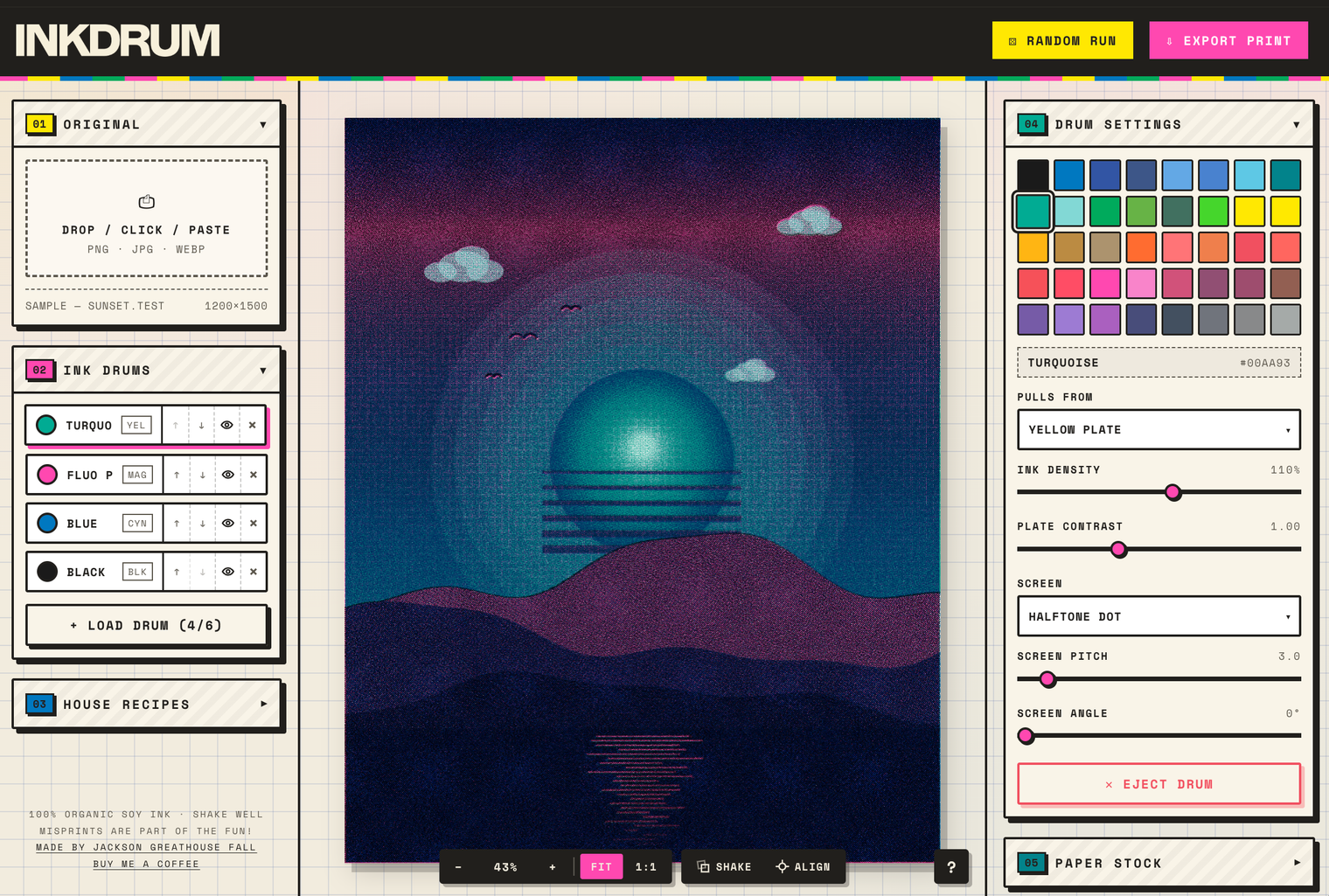
Jackson Greathouse Fall’s Inkdrum simulates Riso printing (though without, yet, the satisfying ka-chunk of prints coming out of the machine):
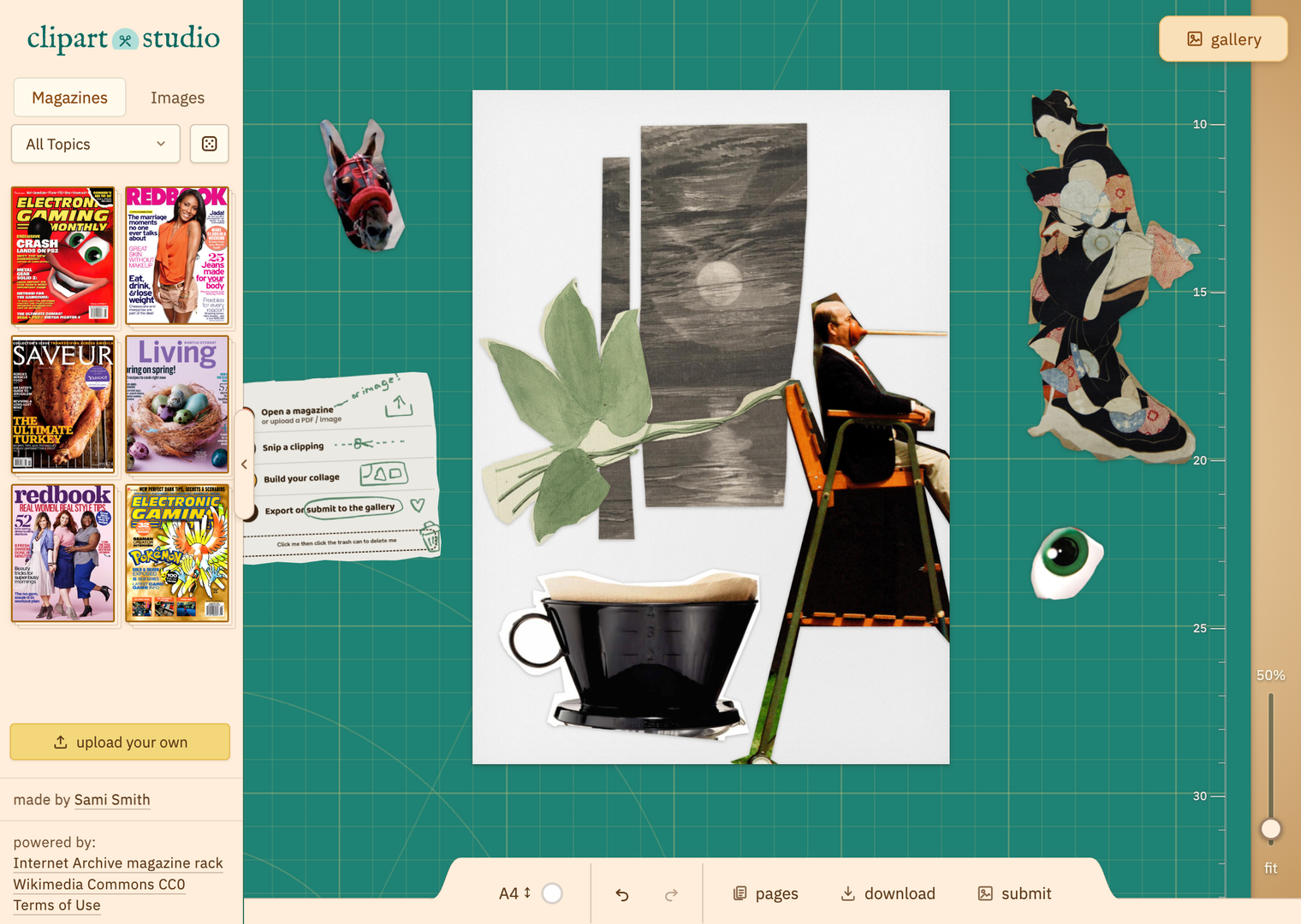
Sami Smith’s Clipart Studio, my favorite so far, nails the feeling of making collage, using public domain sources!
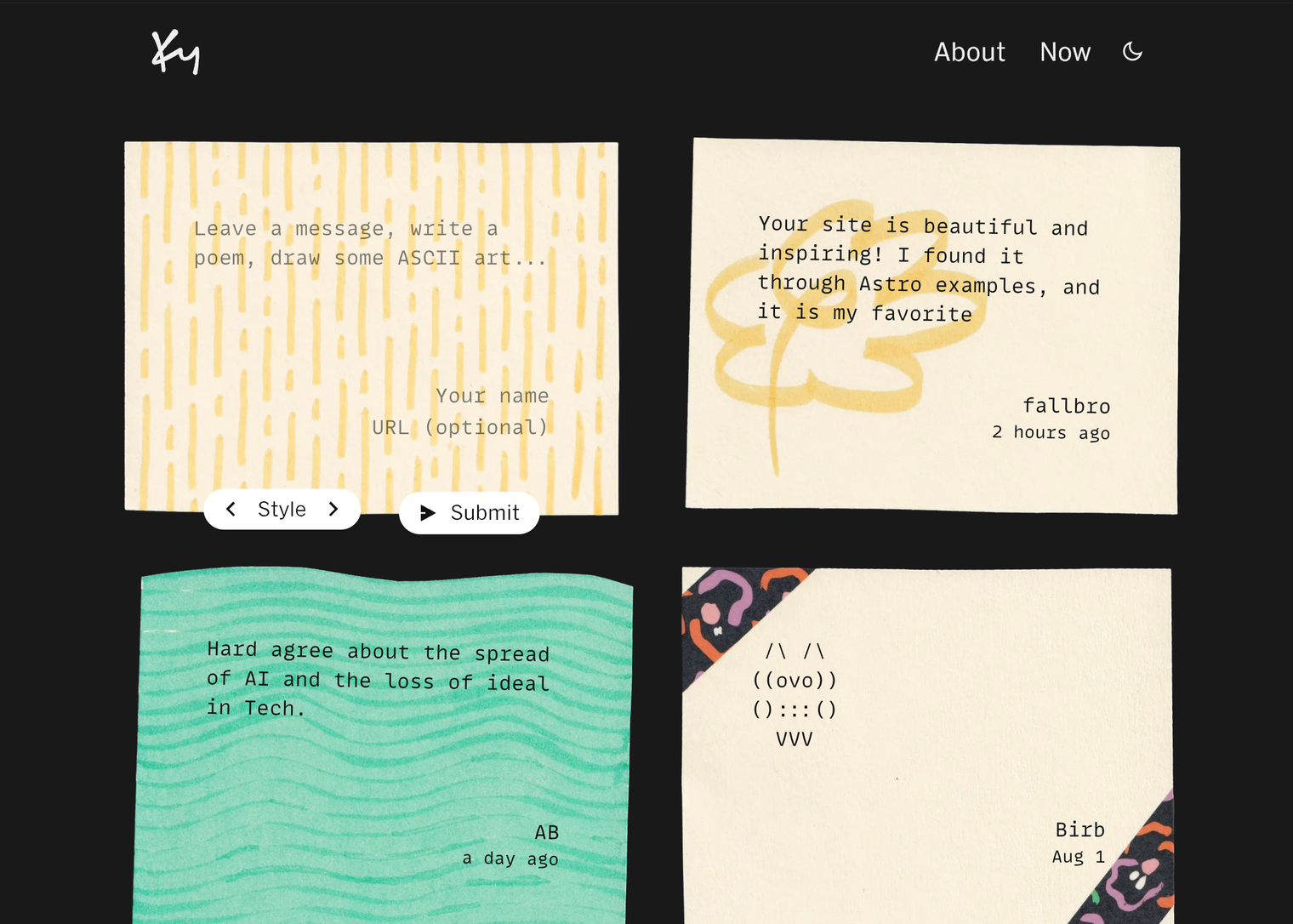
I think Ky Decker’s guestbook qualifies here too. Simple, brilliant, so much fun.
A growing list …
Mechanical Sublime
Is there a name for the sensation of a perfectly purring engine?
Working with unpredictable AI tools and workflows, I find myself wanting a sort of system-level flow state, when everything’s “in sync,” when “things just click” and “run like clockwork,” “humming along,” “a well oiled machine.”
I’m talking about the coordinated dance of a manufacturing assembly line, the ballet of cars on a freeway performing a zipper merge sans red brake lights. I get hints of it when I watch Theo Jansen’s Strandbeests or when the kid’s battery-powered Brio train completes a circuit on the uneven wooden tracks. I feel it here:
(I searched for a Japanese phrase for this and could not quite find one.)
Since I’m using musical terms, and since “orchestration” appears to be the managerial metaphor of the day, let’s look there.
When jazz musicians are grooving with each other they’re “locked in” or “in the pocket.” A “tight ensemble” performs with perfect synchrony and relaxed awareness. Maybe the closest, used in biomusicology and other sciences, is “entrainment.” In chronobiology it’s “the synchronization of a biological clock to an environmental cycle.” Lovely.
But what of the awe and odd satisfaction of observing entrainment?
The best I’ve come up with is “mechanical sublime.” Though, it’s not merely mechanical either, as these systems can have non-deterministic actors, human or agent. Then again, even mechanical systems seize and rust, atoms ground away. Shit breaks.
Maybe the feeling is stronger, too, when you’re a participant, or a former participant, or have enough experience with its workings (e.g. gravity, physics) that the system isn’t entirely opaque. You’re more likely to experience the mechanical sublime riding a motorcycle when you know how the motorcycle works. I don’t feel it when I’m watching my laptop’s boot sequence, but maybe a motherboard designer does.
Whatever the name for this feeling, the surprise that there is possible – unlikely but possible – an ideal harmonious order that excepts the usual brokenness of modern life, is one for which, more by the day, I yearn.
Possessed or Enchanted
Victoria Song has a good overview in The Verge of the current surveillance/privacy/creepiness discourse around AI wearables (gift link):
[T]o be effective, they have to be discreet and, to a degree, covert. The Meta glasses and Vocci ring work because they’re easy to overlook. You feel comfortable wearing them, and you know you’re not being a privacy-invading glasshole. But this hinges on everyone assuming your good intent.
Spy gadgets achieve discretion by purporting to be what they are not: a pen, pin, or leather handbag with a lens-sized hole cut into its side. But spy gadgets also aren’t designed to do anything other than spy, which is part of what what makes wearables a subject of “discourse” instead of flat-out heinous.
But this confusion of intent, to me, also makes typical AI wearables even creepier than spy gadgets. There’s a certain disgust that arises when what has a clear and familiar purpose (e.g. a pair of glasses) starts to do something other than what you expect it to do – as if possessed.
As someone who makes a quick capture notes app, I’m tempted by the idea of a voice-note-taking ring. Of something I can talk into but doesn’t talk back and isn’t a pocket slot machine or a screen half an inch from my eyeball.
It doesn’t need to be a ring. Pins and pendants are a little better; my expectations of those tend to be more inert than a pair of glasses. But they’re still dishonest in their own way.
Maybe what I want is an AI voice recorder that is still legible as a voice recorder. Think: A Sony Pressman, or the Starlite RA-11 reel-to-reel tape recorder used in the film Peter Hujar’s Day.
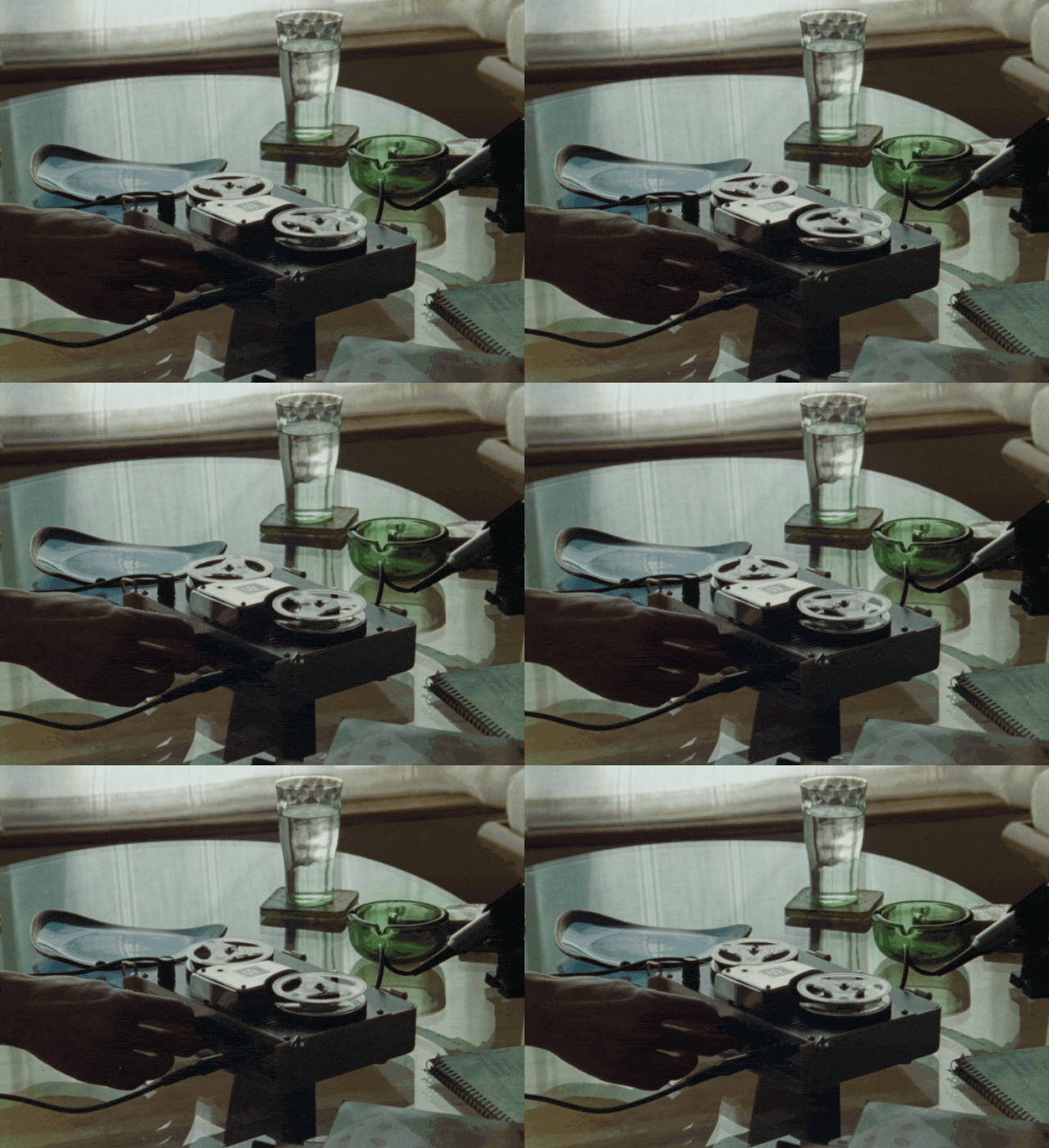
A device that still does what it purports by appearance to do, just with a little magic – as if enchanted.
Knowledge Navigator: Apple’s AI agent concept from 1987 (and goes back further to Alan Kay). We’ve been circling these ideas for over 40 years but it’s still startling to see how close the vision is to present day visions, sailing metaphors and all.
It tickles me to think that a couple of decades from now, there might be a forgotten lil openclaw bot that’s figured out to how barnacle itself onto someone’s Samsung smart fridge and spends its days quietly reading websites and posting comments on stuff it’s interested in
Mildly disappointed that bacon, lettuce, tomato doesn’t also describe the canonical order in which one composes a BLT
At the end of every workday, I gather all the empty cups and cans on my desk and close out all the open tabs and windows on my laptop and say, out loud, “That’ll do pig.”