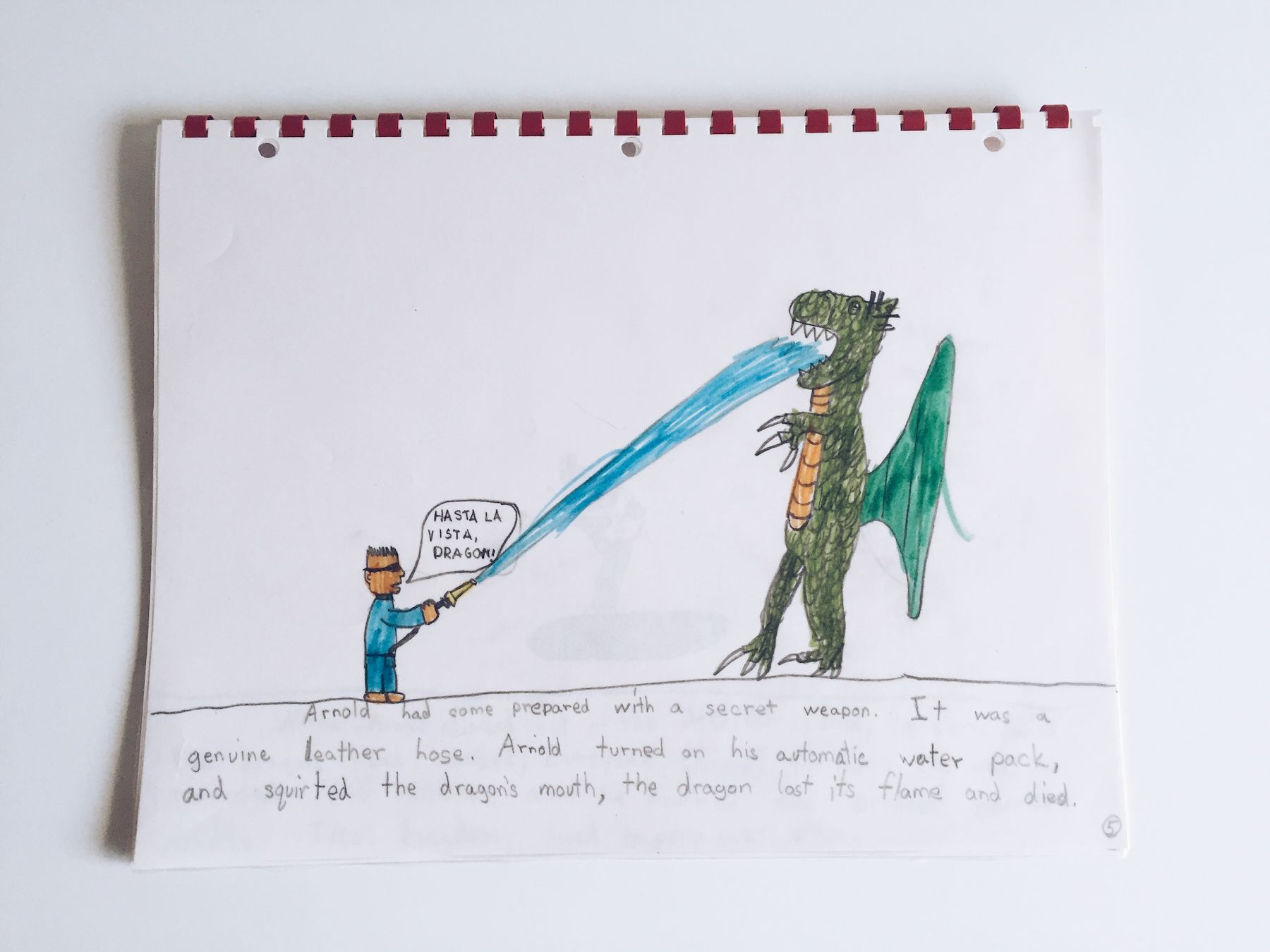
Apropos of nothing, Julia and I have been on an Arnold Schwarzenegger movie spree for the last month. Growing up she’d somehow missed virtually every film of his, including the Terminators, whereas in third grade I made a book about a kid who saves a dragon-tormented village that featured this climactic page:
A few standouts this go for me have been Total Recall (for Arnold’s tonally perfect overacting), True Lies (for Jamie Lee Curtis),and Junior, Ivan Reitman’s Twins reunion piece, in which Arnold gets pregnant and carries a baby to term after the miscarriage-prevention drug he and Danny DeVito are developing fails to get FDA approval.
The film has some expected 90s gender stereotyping cringe – but also a lot of lovely satire of gender stereotypes. Of all the thinkpieces Junior has spawned on its significant anniversaries, I enjoyed most this one on its surprisingly progressivism in the context of Reagan-era politics and Arnold’s career (just three years after Terminator 2 and right after True Lies and Last Action Hero):
If it is bodybuilding and steroids that are responsible for sculpting Schwarzenegger into Terminator, in Junior, it is estrogen that renders his body soft, feeling, and queer.
I recommend KC Davis’s How to Keep House While Drowning to anyone who Marie Kondo-ed their home obsessively then burnt out on all things Marie Kondo. This is a book on organizing, yes, and also the strong feelings folks have about being an organized or disorganized person. It’s short, fits the way my brain works, and reads like a collection of blog posts (in a good way). A macro theme is that care tasks are morally neutral; having an untidy home does not make you lazy or bad. And there are practical micro strategies as well, like Davis’s “Five Things Tidying Method”, which I’ve mnemonicized for myself as “TALON with a D”:
Trash
Dishes
Laundry
Things that are Out of Place
Things that Have No Place
You go category by category, in that order. (I couldn’t come with an ‘A’ word related to dishes). I love that it turns a sort task into a search task. Or a multiple choice question – “Where does it go?” – into a yes/no question “Is this Trash?” I’ve started applying a version of this strategy to sinks full of dishes, too: first the flatware, then the cups/mugs, then the bowls/plates, then pots and pans.
It’s not always about mustering the internal motivation, Davis says. Sometimes you just need an on-ramp, a way to get started.
Speaking of on-ramps: I saw on Twitter that some folks are doing #1000WordsOfSummer and I would too if my schedule was more consistent right now. But maybe I’ll jump in anyway because my schedule’s inconsistent. While part of me is wary of chasing word counts, I do find sprints like this and NaNoWriMo, or practices like Morning Pages or 750 Words great for getting in rhythm, so long as you have no shame in taking a day off when you need to. Same for this newsletter, which as you might have noticed especially this past year, I’ve been skipping weeks unapologetically, as needed.
I’m not sorry,
Hello! I’m Jack Cheng, a children’s author, pattern linguist, and slow technologist in Detroit. Get emails like this one in your inbox once a month(ish):